Note: I recommend reading Asphalt before reading this rewritten version.
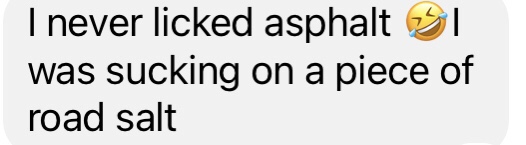
Minutes after I post a story about my mother licking asphalt as a child, I receive a message from her. She informs me that she never licked asphalt; her brother found her sucking on a piece of road salt.
If this were a television show, you would see the entire asphalt scene rewinding. The TV would make a “vuRRRRRRrrrrooooooooo” sound while this was happening until the screen went white with a few thin black lines. The number three with a semi circle would flash into view briefly before the screen turned black. Did you see all that? Good. Let’s start again.
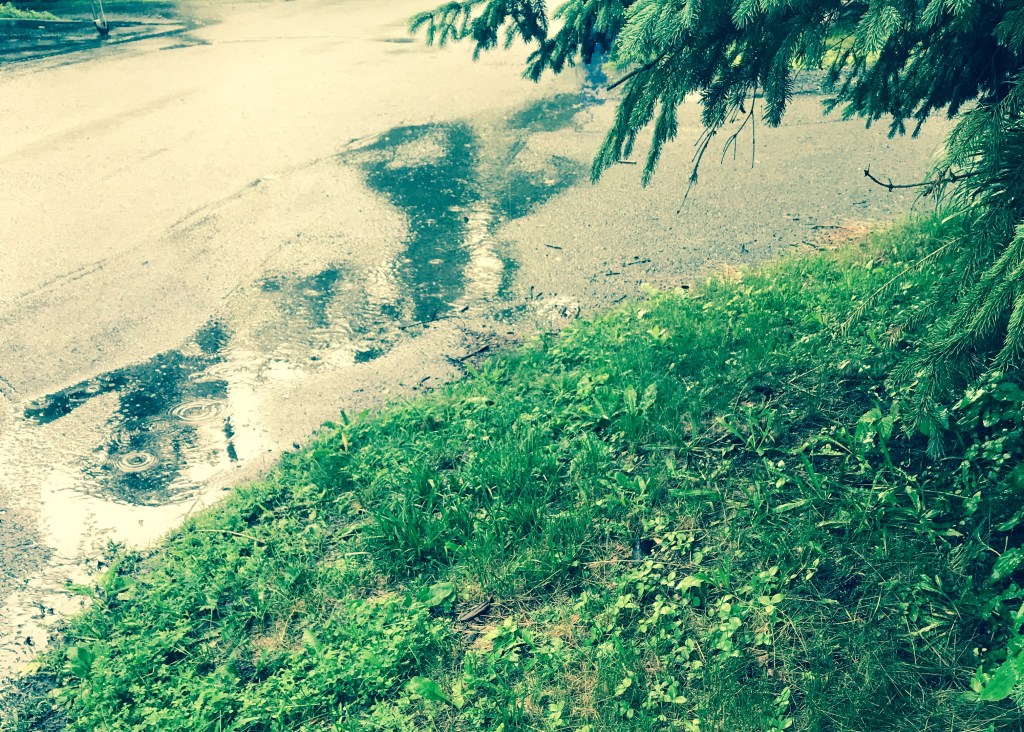
The sun has finally come out in a small town in rural Ontario during my mother’s childhood. It’s late winter, almost spring. The ground is squishy and grimy piles of snow shrink next to shiny puddles of water.
My uncle ventures outside so he can walk to the store. The air is still cool in some spots after a long winter, but the sun is starting to warm things up. My uncle is looking forward to a pleasant walk, but then he sees a small figure in a snowsuit at the end of the driveway. Something about the way the figure is hunched forward with its back to him seems wrong. As the oldest child in the family, he feels that it is his duty to investigate.
My uncle approaches this figure and the head turns to look up at him. It’s his younger sister, my mother. She has a little bit of blood on her lip. Her mittens are dangling from strings coming out of her sleeves. He is horrified when he sees the large chunk of road salt grasped in her small, cold, reddened hands. It is light beige with splotches of pink on it. He wonders if her tongue and the inside of her mouth are also bleeding.
“What are you doing?” he asks. He can feel a ball of panic crawling up his throat.
“Nothing,” she says. She begins to raise the road salt back to her mouth.
“Don’t do that,” he says sharply. She lowers the salt and looks at him with suspicion.
“Why not? It’s just salt.” She raises the salt again. He puts his hand on her arm to stop her.
“It’s poison,” he says. “It’s not the same kind of salt that you can eat.”
“Why not?”
“Because you could die.”
Her eyes are wide and grey. “I could die?” she says in awe.
“Yes. How much did you eat?”
“I don’t know.” She begins to cry. “What should I do?”
He tries to think. What should they do? Maybe flush the salt out with water? The ball of panic succeeds in bursting out of his mouth in the form of words.
“You have to drink 80 gallons of water.”
And that is the story of how my grandmother found my mother sitting on the kitchen floor on a sunny afternoon in late winter, sobbing as she drank glass after glass after glass of water.
 Raccoon Brontosaurus