Oh, deer

My father prefers fishing over hunting. It’s just more fun to be on a boat on the lake when the water is calmly reflecting the brilliant sun. Hunting, though? He technically can’t go anymore, but that doesn’t bother him. It’s probably been at least 30 years since he went and he doesn’t miss it. That doesn’t mean that he doesn’t appreciate it when a friend goes hunting and brings back a treat for him, though. I’m just putting that out there in case any of his friends are reading this.

Today we set our scene in a townhouse in the late 1980s. Lunch time is coming up fast and my dad has been looking forward to the venison that his friend gave him. It is in the fridge wrapped in tinfoil. He opens the door and pulls the silver corners of the wrapping open and pulls a piece of meat out. He takes a bite.

Delicious. That’s what it is, deeeeelicious. He thinks to himself, Hey, you know who might like this? My five-year-old daughter.

There is really no way for him to know that I watched Bambi for the first time at Aunt Shirley’s house yesterday.

My father calls me over.

“Here, try some of this. You might like it.”

I look at the meat with interest. “What is it?”

“It’s deer meat,” he says.

I recoil and shake my head, frowning.

“Come on, it’s yummy,” he insists.

“No, I don’t want it.”

“Why not?”

“I don’t like deer meat.”

“How do you know if you don’t try it?”

I shake my head again.

My father is running out of convincing things to say. It’s time to pull out the big guns. It’s time to bust out his favourite Pink Floyd lyrics.

“If you don’t eat your meat, you can’t have any pudding,” he says.

I stare at him. Tears are beginning to form in my eyes.

My dad puts on a silly accent and says, “How can you have any puuuudinnggg if you don’t eat your meat?”

That’s when I burst out with, “I don’t want to eat Bambi’s mom!” The tears are rolling down my cheeks and my eyes are glistening as I look up at him.

This is a plot twist that my father was not expecting. He quietly wraps the deer meat up in the tinfoil and puts it back in the fridge.
Asphalt rewritten

Note: I recommend reading Asphalt before reading this rewritten version.

Minutes after I post a story about my mother licking asphalt as a child, I receive a message from her. She informs me that she never licked asphalt; her brother found her sucking on a piece of road salt.

If this were a television show, you would see the entire asphalt scene rewinding. The TV would make a “vuRRRRRRrrrrooooooooo” sound while this was happening until the screen went white with a few thin black lines. The number three with a semi circle would flash into view briefly before the screen turned black. Did you see all that? Good. Let’s start again.

The sun has finally come out in a small town in rural Ontario during my mother’s childhood. It’s late winter, almost spring. The ground is squishy and grimy piles of snow shrink next to shiny puddles of water.

My uncle ventures outside so he can walk to the store. The air is still cool in some spots after a long winter, but the sun is starting to warm things up. My uncle is looking forward to a pleasant walk, but then he sees a small figure in a snowsuit at the end of the driveway. Something about the way the figure is hunched forward with its back to him seems wrong. As the oldest child in the family, he feels that it is his duty to investigate.

My uncle approaches this figure and the head turns to look up at him. It’s his younger sister, my mother. She has a little bit of blood on her lip. Her mittens are dangling from strings coming out of her sleeves. He is horrified when he sees the large chunk of road salt grasped in her small, cold, reddened hands. It is light beige with splotches of pink on it. He wonders if her tongue and the inside of her mouth are also bleeding.

“What are you doing?” he asks. He can feel a ball of panic crawling up his throat.

“Nothing,” she says. She begins to raise the road salt back to her mouth.

“Don’t do that,” he says sharply. She lowers the salt and looks at him with suspicion.

“Why not? It’s just salt.” She raises the salt again. He puts his hand on her arm to stop her.

“It’s poison,” he says. “It’s not the same kind of salt that you can eat.”

“Why not?”

“Because you could die.”

Her eyes are wide and grey. “I could die?” she says in awe.

“Yes. How much did you eat?”

“I don’t know.” She begins to cry. “What should I do?”

He tries to think. What should they do? Maybe flush the salt out with water? The ball of panic succeeds in bursting out of his mouth in the form of words.

“You have to drink 80 gallons of water.”

And that is the story of how my grandmother found my mother sitting on the kitchen floor on a sunny afternoon in late winter, sobbing as she drank glass after glass after glass of water.

The baby

Late August vacations span warm days and cool nights. It is a time when both mosquito and tourist populations are beginning to dwindle. It’s a good time to take my son on a road trip.

My car is the only one in the dirt parking lot surrounded by tall pine trees. I can hear the cars on the nearby highway where the entrance to the campground is. I’m carrying the firewood while my son clutches the map of the campground that will help us find our site. I open the hatch of my car and drop the wood inside. I’m about to close the hatch again when I see her.

She walks out into the parking lot from a line of trees, a baby in a summer outfit with a cotton sun hat and a white pair of sandals. She’s a little bit wobbly and probably only learned how to walk recently. She stumbles and puts her hands down to catch her fall. She’s only down for two seconds, and then she’s back to wobbling her way across the parking lot.

I look around. Nobody else is here, nobody followed her from behind the trees. I completely forget about closing the hatch of my car and walk towards her, my son trailing behind me.

The baby looks a bit nervous when I pick her up. She half-heartedly tries to escape before settling into my arms. My son says, “Are you sure we should be doing this?”

We walk towards the trees where she came from. There’s a small road lined with campsites. The first campsite has an older couple sitting on lawn chairs. I say, “Excusez-moi, avez-vous perdu ce bébé?”*

“Non!” they say, shaking their heads vigorously. They looked scandalized, but I now have their rapt attention as I go to the campsite across from them. I feel like the little girl in Robert Munsch’s Murmel, Murmel, Murmel.

The next campsite has a young guy grilling steaks on a portable charcoal barbecue. He looks up at me casually when I ask my question, and then looks down at the steaks again. Then his head snaps back up to look at the baby that I’m holding. He rushes forward to claim her.

“Je suis désolé!” he exclaims. “C’est ma blonde qui devrait la garder.”**

His girlfriend yells from the camper that she’s in the bathroom. They start to bicker.

As I turn to leave, I get two enthusiastic thumbs up from the first campsite I visited. My son says, “That went a lot better than I thought it would.”

I think about that baby all the time. My son doesn’t remember her. When I tell him the story, he says, “Did you find its owners?” and I say, “You mean her parents?”

*Excuse me, did you lose this baby?

**I’m sorry! It’s my girlfriend who should be watching her.

Asphalt

The sun has finally come out in a small town in rural Ontario during my mother’s childhood. When my mother sees it, she shoves her feet into her running shoes and runs outside.

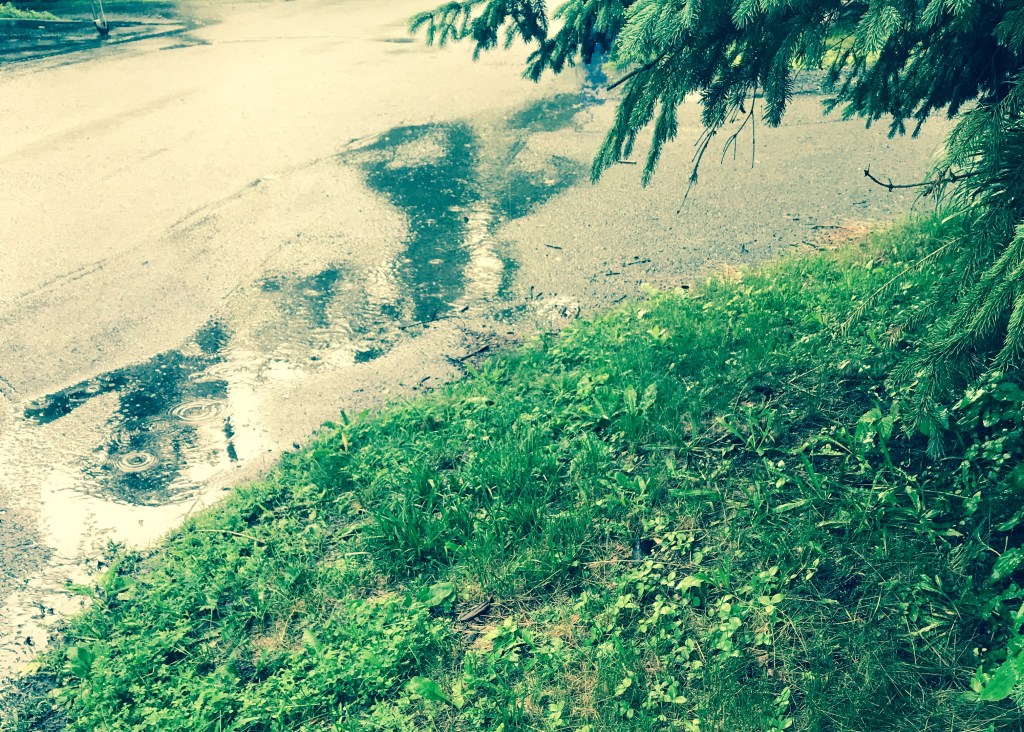
The air is still cool in some spots after a rainy morning, but the sun is starting to warm things up. She walks to the front yard and sees that the road is still dark from the rain, but the sun is making it sparkle a little bit. She looks closer and sees that the black asphalt is really made out of a million tiny different colours.

Seeing the colours in the sun after the rain and seeing the sparkles gets my mother thinking: what does asphalt taste like?

Small pebbles imbed themselves into the palms of her hands as she leans down and sticks her tongue out.

Dirt. It just tastes like dirt.

“What are you doing?”

My mother scrambles to get off of the road. Her older brother is watching her.

“Nothing,” she says, trying to sound relaxed.

“Were you licking the asphalt?”

“No,” she says, her voice suspiciously high.

“Okay, good,” he says with exaggerated relief. “You could die from doing that.”

Her eyes are wide and grey. “I could die?” she says in awe.

“Well, yeah, it’s poison,” he says. “You would have to drink 80 gallons of water if you didn’t want to die, and even that might not work. It’s a good thing you weren’t licking the asphalt!” He laughs and walks away.

And that is the story of how my grandmother found my mother sitting on the kitchen floor on a sunny afternoon, sobbing as she drank glass after glass after glass of water.

A perfect moment

I spend more time helping my son with his homework than I spent on my own homework when I was in high school. Every day we come home and do homework until it’s time for bed.

One night I help him with French reading comprehension. It is a slow and laborious process. He reads a sentence out loud. I say, “Okay, so what did that mean?” He says, “I don’t know.” Sometimes I just want to tell him, it would be faster if I just did it for him, but I don’t do that. We go through the sentence word by word, defining each one. I make him look up the ones he doesn’t know, which is almost all of them.

My shoulders are aching. There is an invisible string running from the crown of my head to the ceiling, maybe a spiderweb. It’s so fragile, and it’s the only thing holding me up. My son is tired, too. His voice slow and choppy. Neither one of us wants to be doing homework right now. I yawn and stretch and then I hear a sound.

“Eliot,” I say, “are you purring?”

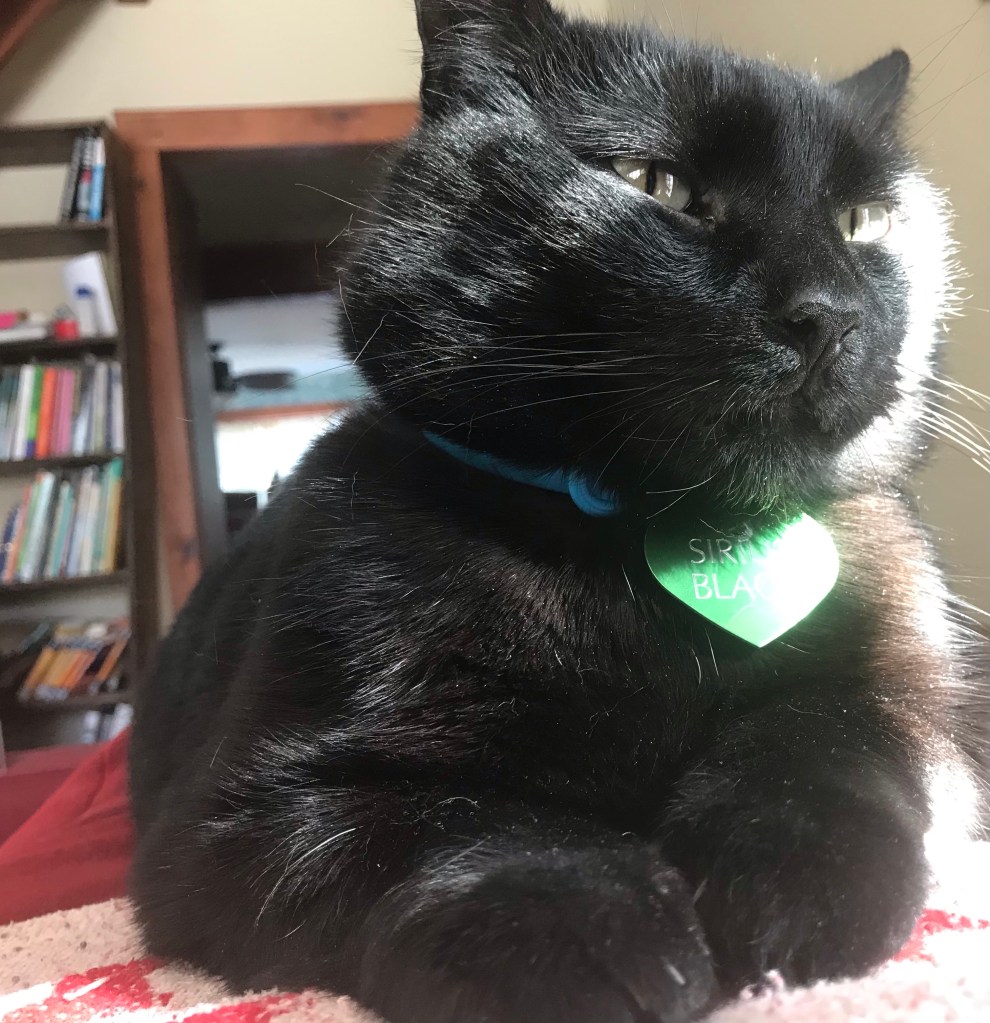
“No,” he says, annoyed that I’m asking such a stupid question, “it’s Sirius.”

I look down to see a soft, glossy cat wedged between us on the couch. His eyes are almost completely closed and his ears stick straight up into the air. His front paws rest gently on the couch, pointing slightly towards each other. For him, this is a perfect moment.

Just try it

My parents are getting ready for the arrival of a new sister. They tell me that the baby could be a girl or a boy and I should be open to the possibility of a brother, but I know I’m getting a sister. I’ve waited five long, gruelling, lonely years for a sister. I don’t want a brother.

My mom and dad are busy offering and rejecting names for the new baby. Cameron, Renée, and Pascal are all vetoed. Finally, my parents turn to me.

“What do you think we should name the baby?”

I’m glad they asked me, because I have an idea for the most lovely, the most wonderful, the most perfect name that anyone on this planet has ever heard.

I sit up straighter. I look at my parents to make sure that they’re both ready to hear this beautiful name.

“I think you should name her Lasagna,” I say.

Try saying it out loud with a dreamy and faraway look in your eyes. Lasagna. Feel the shape your throat makes when the sound comes out, feel the soft vibrations. La zahhhhn nya.

Just try.

Dad’s rock

Are you celebrating Father’s Day this weekend? Some people are. They’re going out to brunch, they’re having barbecues, maybe they’re going to the beach. I’m going to celebrate by telling you about my dad’s rock.

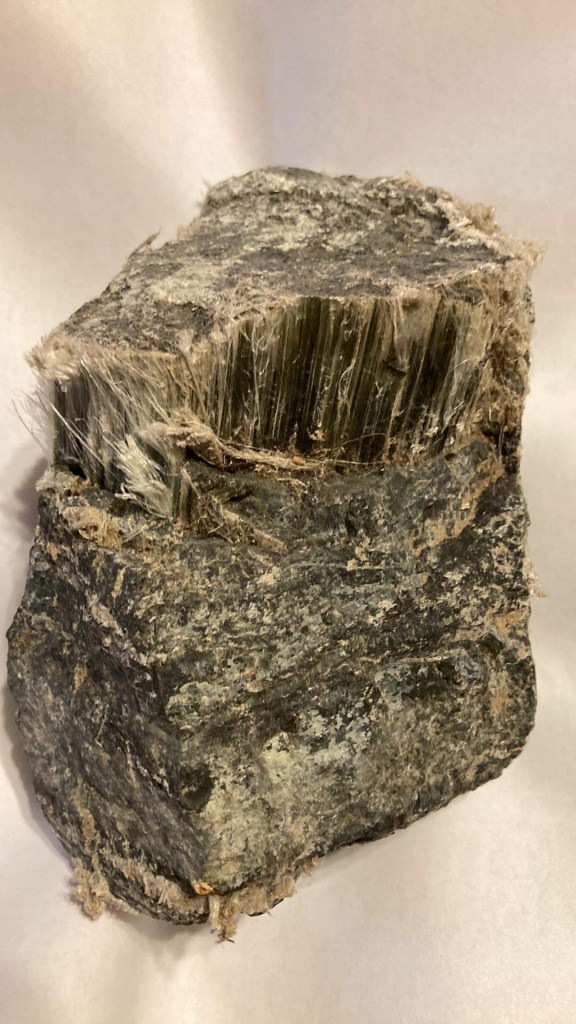
He’s very proud of his treasure as it is a family heirloom. It’s the colour of gravel and made up of tiny, column-like threads. It looks like an Escher print is trying to escape from it. He keeps it in a ziplock bag, which he is not able to close because the rock is too big. The reason why he keeps it in the ziplock bag is because it is an asbestos rock.

Photo by Claude Grenier

The rock was hacked out of the earth with a machine that made a grinding and halting sound. My dad’s uncles worked in the asbestos mine, and it wasn’t the dark, buried place that you think of when you hear the word “mine”. The sun shone on the large trucks as they drove up and down roadways that cut through rough steps that led up to the sky. My dad’s rock came out of the mine one day and somehow ended up in my grandfather’s possession. It was at one time bigger than it is now, but it shrunk over the years as Grandpa would occasionally break a piece off to give to various friends and relatives. He eventually gave the whole thing to my dad.

When my uncle found out that my grandfather gave the rock to my dad, he was mad. He wanted the asbestos rock. It should have been given to him. He is the oldest, after all. My dad disagreed with him. He thought that the correct person received the rock from my grandfather. They fought over this cancer-causing substance as only siblings can.

My dad still has the rock. As long as he doesn’t break it, he’ll probably be safe.

My dad is animated as he tells this story to me and my husband, Phil, who removes asbestos from old buildings for a living. He wears a hazmat suit and keeps a close shave so that his mask seals itself to his face properly.

My mother and the snake

It is always windy at my mother’s house because there are no trees or buildings to block the wind. Her house rises stubbornly out of the flat ground like a small mountain.

My mother is outside ripping weeds out of her garden. It is satisfying when the roots emerge. She shakes the dirt out of them and lays the unwelcome plants on the ground, but then she hears another sound under the sound of the wind.

Knock knock knock.

It kind of sounds like a woodpecker, but less rhythmic and more hollow.

She follows the sound. She walks around the house and sees a snake. Its scales are rough and dry and dark grey. It has a large snail stuck to the side of its head. It is banging the snail against the steps leading up to the deck, trying to knock it off.

My mother wants to help. She looks around for something that she can use to get the snail off of the snake’s head. She sees a hockey stick and picks it up.

The snake doesn’t know what my mother’s intentions are. It just sees a lady coming towards it with a hockey stick, and, because the snake has dealt with enough bullshit today, it swiftly darts under the deck and out of reach.

Dinner

The stew slides out of the can with a schlurrrrrrrrp. It retains a cylindrical shape until I smash it up with a wooden spoon. Beige, orange, and brown cubes with rounded corners swim in a brown puddle. That’s the potatoes, carrots, and meat. The beef is made of highly processed hamburger meat, ground up again and again before being pressed into a shape.

I know that it is ready when the stew sizzles and spits.

I take the French fries out of the oven. I scoop some onto a plate and I dump the stew on top of the French fries. I set the plate down in front of my surprised son.

“My dad used to make this for me when I was a kid,” I tell him.

“Oh.” He pauses to take a hesitant bite, and then he says, “Did you like this when you were a kid?”

The decorations

Picture a cemetery on a cold and sunny day in October. The sky is blue, the leaves are orange, and the headstones are sticking out of the ground like big, somber, grey popsicles. Now zoom in on my identical twin aunts. You can tell them apart when you see them, but not when you hear them both laughing at the same time. Today they are visiting my grandparents and they have supplies.

They decorate my grandparents’ headstone. The decorations are placed meticulously and thoughtfully. They stand back to admire the lavish display that they’ve created. My grandparents would love it. My aunts’ voices fade as they walk back to their cars. The sun puts on a show with dark reds, oranges, and yellows stretching through the sky, and then it fades, too.

The cemetery is quiet and dark. The wind keeps the headstones company. The sun returns and the sky turns blue again. The first mourners of the day come to the cemetery with flowers. They are startled when they see the plastic skeleton guarding my grandparents’ stone. As they take in the scene more, they also notice the rubber bats, the fake spider webs, the autumn flowers, and the pumpkins.

My grandparents really liked Halloween.