Whale watching

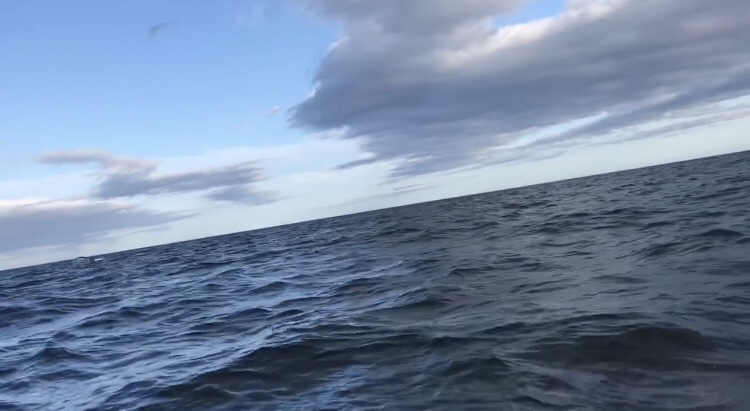
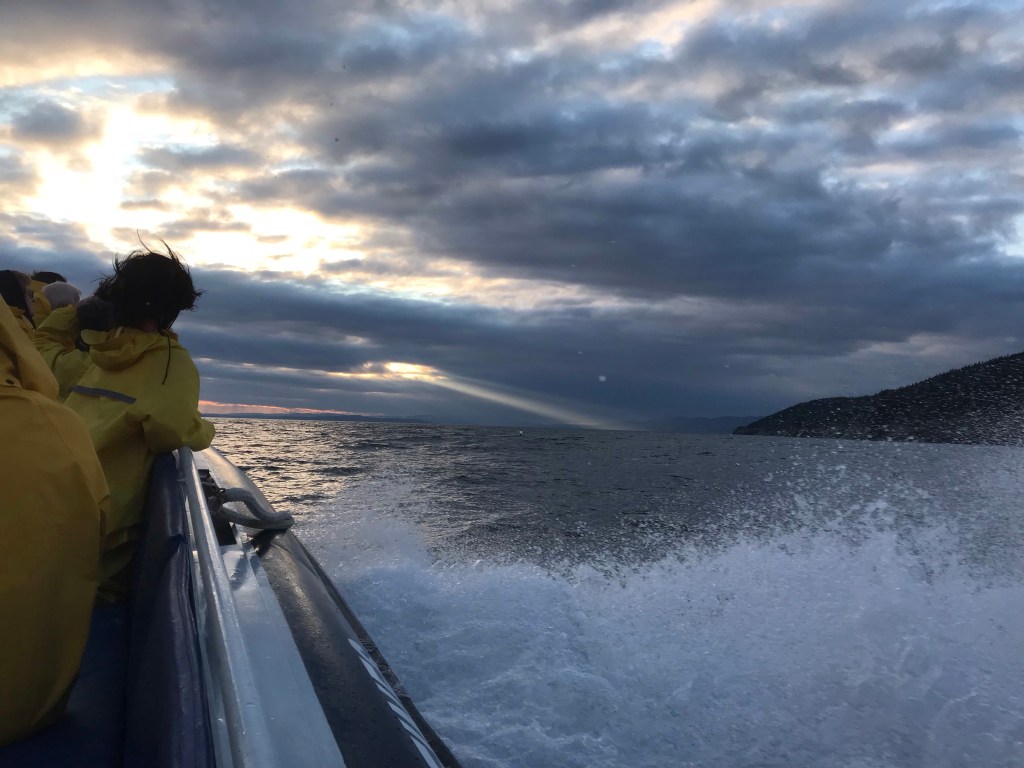
The boat jumps up and down on the waves like a volleyball leaping over a net. Even without the connection to my least favourite sport, I’m not feeling super amazing. I try to concentrate on the tour guide’s fun whale facts and the soft weight of my son’s head on my shoulder and not on my stomach.

“I don’t feel good,” my son says. I look down at him. His arms are hugging his stomach and he is staring at the bottom of the boat.

“I’ll go get a barf bag,” I tell him. I give him a gentle pat on his shoulder and walk up to the tour guide to ask her for one the bags that she waved around in the air and stuffed into the pocket of her fleece jacket at the start of the tour.

She is still reciting her whale facts, and she puts a finger up, indicating that I should wait. When she finishes her sentence, I ask her for one of the bags, but when I have it in my hand and I turn around, it is already too late.

My son’s vomit is all over the bottom of the boat. Another mom is sitting next to him and rubbing his back with concern. As I watch the scene with the empty barf bag in my hand, I feel that I have failed him.

I clean my son up with tiny, brown, ineffective paper towels. The smell and the rocking boat make my stomach want to empty itself as well, but I manage to hold it together.

When we get home from our trip a few days later, my son tells me that his favourite part was the whale watching tour.

It’s just for a minute

I’m twenty-one years old and I’ve recently moved in with my boyfriend. One weekend, I go back home to visit my family, but nobody is able to give me a ride back to the train station when my visit is over. My mother suggests that I ask my paternal grandparents. I call my grandma and she agrees to help me out.

The day before I leave, my grandmother calls me and says that they’re going to pick me up early so we can go out for breakfast first. I’m a little surprised by the early time she gives me, but I am still not suspicious.

Morning arrives. The sky brightens while the mist floats a few inches off of the ground. A blue heron stands like an old tree in the pond next to the house. My grandparents arrive, too. I climb into their van with my backpack.

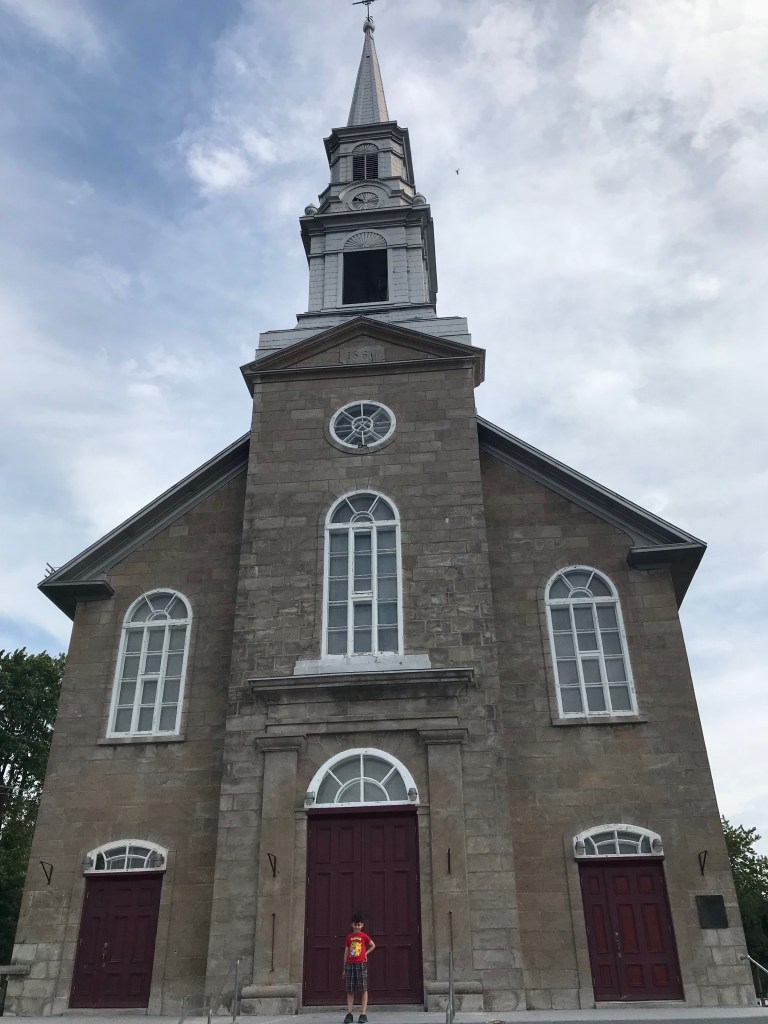
My grandpa is relaxed in the driver’s seat as the van slowly makes its way through the country side. My grandmother is relaxed, too, and she sits up tall. The radio filters through the van quietly. We pull up in front of a Catholic church.

It wasn’t this specific church. This is just another church that I happen to have a picture of.

“We just have to go in here for something first,” my grandma says evasively. “It’s just for a minute.”

While we’re sitting through the hour-long mass, I think, Are we still going out for breakfast, though? Because I didn’t eat anything.

Coffin

Papa knows that his cat will die soon and that there is nothing he can do. This cat has lived with him for sixteen years, so this situation is not unexpected. Papa will show his appreciation for his friend by building him his own custom-made coffin.

The cat lifts his head briefly when Papa brings his measuring tape. He is too old and sick to be overly curious. The fur around his nose and eyes has become frosted and dull over the years and his body is thin and frail. He patiently allows Papa to measure him.

With the measurements in hand, Papa goes out to his workshop. He loudly builds a box that the cat will quietly rest in for eternity. After all the sawing and the hammering, he inspects it. It’s a good and sturdy coffin, perfect for a good and sturdy friend, but when the cat dies, it turns out that he no longer fits in the box.

Papa tells me this story in my mother’s kitchen after Christmas dinner. Nobody knows it yet, but this will be his last Christmas.

My mother walks in as Papa is saying, “And he knew that I was measuring him for his coffin, too. Anyway, he died that night, and his whole body swelled up and wouldn’t fit in the coffin. I had to shove him in there, and I was banging down on the lid—”

My mother is so shocked that she has to interrupt. “Who are you talking about?” she demands to know.

In which my son strongly dislikes some guy we don’t even know

It’s 2016, my son is seven years old, and we are boarding an airplane. We arrive at our row and the young man in the window seat greets us politely.

My son is angry that this guy has the window seat.

I am surprised by this reaction because my son hates flying. The last time he had a window seat on a plane , he cried out, “Oh no, we’re all going to die!” while we were landing at the airport. He wasn’t trying to scare the other passengers to be mean, he just thought that what he was saying was accurate.

When you’re not afraid of flying, it is difficult to know what will help someone who is afraid to feel better. Apparently, specifically choosing non-window seats while booking the flight is not helpful.

My son is telling me that he wants the window seat and asking me why he can’t sit in the window seat. I explain to him that I chose to not have window seats and I explain why. He is not satisfied with my answer, so I explain that the passenger in the window seat probably also specifically chose his seat, and he chose the window, and it wouldn’t be fair to ask him to switch seats when he specifically chose a window seat and we specifically chose non-window seats. I also explain that we should probably just leave the guy alone because we don’t want to be rude jerks.

“Okay, fine,” my son grumbles. I give him a comic book and he settles down, but his face still looks slightly sulky.

The plane turns on. The engines make all of the voices of all of the passengers sound muffled and hushed. The flight attendants do their safety pantomime in the aisles as the plane crawls slowly around the airport.

Finally, it’s time for the airplane to shoot up into the sky in a diagonal line. My son tries to look out of our neighbour’s window. He stretches his neck back and forth before saying, “Ugh, his head’s in the way!” and collapsing back into his seat in frustration.

We run into the guy from the airplane the next day when we’re returning from a tour. His face brightens when he sees us.

“Oh, hey!” he says, waving and smiling.

“Ugh, it’s him again,” my son says in disgust.

Boa

I have a memory of my grandmother, sitting in her armchair relaxing. She has a boa constrictor draped over her shoulders. The snake isn’t doing much or reacting to anything. Its face is cool and impassive and its body has twists and turns like a river. My grandmother is tilting her head back and laughing.

“That definitely didn’t happen,” my mother says when I share the memory with her.

“Are you sure?” I ask. “It seems like a really clear memory.”

“Maybe it was a garter snake?”

I shake my head. “No, it was a really big snake.”

“Was it a feather boa?”

“No! It was definitely a snake.”

“Well, I don’t remember that at all,” my mother says decisively.

I’m confused. I often wonder about whether or not I imagined it until one of my cousins tells me that he remembers the snake, too.

The wrong school bus

I know that I’m getting on the wrong bus. Another kid says, “Hey, didn’t you move?” She also knows that I’m getting on the wrong bus. The teacher who is putting me on the bus does not know. I try to tell her.

“I don’t take this bus anymore,” I say. “I think my bus is over there.” I point at the correct bus. She looks at me and then looks down at her clipboard.

I’m just a disheveled kindergartener. I look like I’ve been lost in the wilderness, just aimlessly walking in a circle for days. If I were to find a witch’s gingerbread house as I walked, I would absolutely stand on my tiptoes to pull a gumdrop off of the roof and pop it into my mouth, 110 percent.

The clipboard is neat and orderly, with the papers clipped in a specific way. It lists the bus numbers in numerical order, and then the names of the kids on the buses in alphabetical order.

The clipboard wins the credibility test.

“No, this is the right bus,” the teacher says firmly.

I follow the line of kids onto the wrong bus. My worry increases as the bus rambles along until I arrive at my old bus stop and get out. The other kids are greeted by their parents, but nobody is there for me because my mother is probably at the right bus stop.

I don’t know what to do, so I walk along the county highway to my old babysitter’s house, which is on the way out of town. The scariest part is crossing the road by myself. I wait for what feels like hours for the cars to stop coming before finally bolting across the highway. One car honks at me.

My old babysitter is surprised to see me when she opens the door. I’m panting after my impromptu sprint, dust is sticking to my damp skin. She calls my parents and they come pick me up.

My mother asks why I got on the wrong bus. When I tell her, she tilts her head up slightly, like she’s beginning to nod. Her head doesn’t come back down, though, it pauses as she surveys the situation with elevated eyes. If you know my mother, and I definitely do, you know that her anger is gathering and will be released in a torrential rainfall when she is ready.

My mother calls the school the next day to give them shit, but the same teacher still puts me on the wrong bus like six more times.

Silver monster

A young girl named Bessie is walking home from school in Forestville, Ontario in the early twentieth century. She steps from log to log on the corduroy road that cuts through the fields and trees, occasionally stopping to balance on one foot. In about ten or fifteen years, all of these fields will be full of tobacco, but for now, various vegetable plants stretch out of the ground, waiting to be harvested. The layers of cloth under Bessie’s dress make it puff out, making her look like a triangle with legs from far away. She carries her books and her slate tied up carefully with a piece of leather.

She hears a noise in the distance. It is the most terrible noise that she has ever heard in her entire life. It is a grinding, roaring, clanking noise. She turns to see what it is, but all she can see is a blinding gleam on the road, and it is bearing down on her.

She runs. The hollow sound of her footsteps on the logs is drowned out by sound of this horrid thing. As it gets closer, she throws herself into a field. A sleek, silver monster with an unnaturally wide and somber mouth full of enormous teeth rolls by. The terrible sound fades away with the cloud of dust. Birds begin to sing again.

“I thought it was a monster coming to get me,” my great-grandmother shares decades later when she tells the story of the first time she saw a motor car.

Where are they?

My son is eating all the oranges. The bag becomes smaller and smaller each day. I hear the fridge open in the middle of the night and I say, “Eliot, what are you doing?” and he just says, “Orange,” before stuffing more into his already full mouth.

This is all fine with me. I am glad that he is enjoying the oranges. They’re good for him. He for sure will not get scurvy. The sharp juice floods his mouth when he cuts the orange membranes open with his teeth, allowing the nutrients and vitamins to get to work. This is a very good thing.

But where are the orange peels? They’re not in the compost bin. They’re not in the garbage can. Where are they?

(SPOILER ALERT: They’re in his pockets.)

Sometimes I root for the squirrel

A squirrel rests on its haunches next to a dumpster in the elementary school parking lot one morning when my son is still small. It has found a cherry danish, and what a find it is. The danish is almost as big as the squirrel. It clutches either side of this special treat with its two front paws. Its paws are getting sticky from the sugary glaze, but it is an uncultured rodent, so the squirrel doesn’t care. It nibbles on the cherry danish happily.

We hear a “Ssssscreeeeeeeee!” from the sky, like a pterodactyl announcing its presence in a dinosaur movie. There is an answering chorus of “Scree! Scree!” I look up to see a flock of seagulls coming for the squirrel with the cherry danish.

The squirrel sees them, too. It pauses for a couple of seconds so it can look at the seagulls in terror, and then it drops on all fours and runs with the very in-demand pastry grasped in its teeth.

My son and I cheer the squirrel on as we watch it running for its life across the parking lot and school yard. The shadow from the flock follows menacingly. And they’re gaining, they’re gaining, and—

The squirrel runs up a tree.

Maybe you’re thinking that a tree doesn’t seem like the best place to escape from a flock of birds, but this flock of birds has webbed feet that cannot cling to branches. All the seagulls can do is land on the ground next to the tree and look around angrily while the squirrel enjoys its hard-won cherry danish.